Friday, December 14, 2012

Kwanzaa yangu ya kwanza

I’m started to prepare to go home for the holidays. Not all scholars choose to do this for one reason or another, but I think I need a little vacation.  Because I’m not a traditional student, if I were to stay in Kampala, I would ultimately continue to work on my research day and night as I am doing right now. So, I think this will be a great time to distress, relax and catch up with friends and family for a couple of weeks.

I have been getting some interesting questions regarding how Ugandans celebrate Christmas. I get asked “do they celebrate Kwanzaa?” “Is it a more African Christmas?” to which I just respond “no and no”. I can’t say I’m shocked at how Christmas is celebrated over here. It just seems so much like home – but hot like it’s summer time. Everyday seems to get a little hotter and I sweat more and more. I’m wearing more dresses and shorts due to the extreme heat and find myself getting dehydrated more often because of this as well. But when I go to Oasis or Garden City (malls), I see all the decorations hanging and holiday music playing. To be honest, that’s the only time I feel like it’s Christmas time. Then I walk outside and recall that I’m in Africa.

I do want to address the Kwanzaa question. Many people assume that Kwanza is an African tradition or celebration but it’s actually an African American celebration. Perhaps because ‘kwanza’ is a Swahili word for ‘first’, people assume that it’s an East African tradition. And perhaps people are used to seeing the Kente cloth around this time of year, but again, that’s an African American thing. The purpose of kwanza was to unite the African American community.  It’s really a young celebration when you compare it to other holidays around this time of year. After a little bit of research on what Kwanza was all about, I decided that I should give it a try this year. Sometimes, African Americans come to Africa to discover their roots, I’m not one of those. I came to learn about the culture and government structure as a result of colonialism. But, I am learning a lot about myself and I have learned that my culture is quite unique. And Kwanzaa interest me because it is directly related to my heritage. It isn’t meant to replace a spiritual holiday such as Christmas or Hanukkah, but to unify a community by practicing 7 principles for 7 days (Dec 26 - Jan 1):

  • Umoja (Unity): To strive for and to maintain unity in the family, community, nation, and race.
  • Kujichagulia (Self-Determination): To define ourselves, name ourselves, create for ourselves, and speak for ourselves stand up.
  • Ujima (Collective Work and Responsibility): To build and maintain our community together and make our brothers' and sisters' problems our problems, and to solve them together.
  • Ujamaa(Cooperative Economics): To build and maintain our own stores, shops, and other businesses and to profit from them together.
  • Nia (Purpose): To make our collective vocation the building and developing of our community in order to restore our people to their traditional greatness.
  • Kuumba (Creativity): To do always as much as we can, in the way we can, in order to leave our community more beautiful and beneficial than we inherited it.
  • Imani (Faith): To believe with all our hearts in God, our people, our parents, our teachers, our leaders, and the righteousness and victory of our struggle.

I find all of this to be very interesting, and being that I’ve dedicated this year to learning about different cultures, why not dive into my own unique culture and try Kwanzaa for the first time this year. I know there has been a bit of a backlash to Kwanzaa for some time in the African American community, but I’m going to choose to do this for my own learning experiences.  I would also like to note that all of the gifts that are given during Kwanzaa are handmade. I think that adds a great personal touch to the tradition and meaning of Kwanzaa, if you ask me. These are all principles that I think every person, no matter their race or nationality, can learn from.

This is a big deal to me personally because I grew up in a predominately white area. I was oftentimes the only black female in my classes, so many people made comments to me about being African American and looking African (most of the time not very nice comments).  I admit, I was ashamed of who I was any my ancestors. But, as time passed and I matured, I realized that I have nothing to be ashamed about. What happened to my ancestors wasn’t their fault and it’s in the past now. All I can do is make sure that what they fought for lives on and I pass it down to my children. Since coming to East Africa, I have been questioned repeatedly about my heritage and now I say with pride that I’m African American because it’s unique but more importantly, it makes up who I am inside and outside. But my past doesn’t define my future, it’s my actions that define my future.  I hope that this holiday season, I learn something from my first celebration of Kwanza and that I can teach everyone reading this something too.

If you’re interested in learning more about Kwanzaa, check out the documentary “The Black Candle” or read this interesting article.

Wednesday, December 5, 2012

What My Trip to Europe Taught Me about East Africa

I recently went on a week long trip to Europe to meet other Ambassadorial Scholars, go to the Berlin Rotary Peace Forum, and visit a school in London.  Culture shock wouldn't even begin to describe what I was dealing with as I took advantage of a Starbucks on every corner in Berlin. As fun as the adventure was, I kept thinking that choosing Uganda was the right choice for me. Since I was a little girl, I've always wanted to help others and basically save the world. Well, I know I'm not Wonder Woman (even though my skype screen name says otherwise). But, I do feel as though I can make a difference, even if it is a small difference.

This realization came to me as I was watching "The Lorax". If you haven't seen that movie or read the children's book, I recommend you pick it up. Dr. Suess was an amazing man that had the ability to teach young children how to read as well as teach lessons about equality and social issues. The quote at the end of the movie is what really hit home for me:
 
Unless someone like you cares a whole awful lot, nothing is going to get better. It's not.


That quote really hit home because I had spent the past couple of days listening to Rotarians and Rotaractors from all across Europe discuss what they wanted to do in areas that are plagued with extreme poverty and bad water. I talked to a Rotarian from France about his club's project in Cameroon, and a German Rotarian about his project in Ethiopia. All great projects and for the better good. I even watched a presentation about some European Rotaractors doing an international service project in South Africa called Rotaract Hearts. I just felt as though we all could be doing more.

What I am seeing in Uganda and Tanzania is different than what some of the people were talking about in their presentations. Being on the ground and living among the people gives you a different perspective than just coming to a country every few months to do a project. That's when I thought "why don't any of these well off clubs of Europe or the U.S. partner with some clubs in Africa?" The German Rotarian answered this question for me "There's a negative stereotype about working with clubs in Africa.  People here say they want to help, but they know there may be a risk involved." Now, that's not to say that there aren't clubs in Europe and North America that don't partner with clubs in Africa. I've seen some great projects in Uganda and Tanzania that are a result of partnerships. But, that negative stereotype is what I couldn't shake.

I kept thinking about this conversation with the Rotarian for the rest of the week. There are so many people that have a need in Africa that you would think people would push through those stereotypes and help people. But, I suppose that's not what happens. Even when I was talking to the other Ambassadorial Scholars about my experiences, their reaction to my experience was usually a blank face. I knew they couldn't relate unless they have actually been there, but it was a bit of a downer to realize that they didn't fully understand that people here live more without than with what westerners would consider the "basics to life".

So, after that conversation with the German Rotarian and the other Ambassadorial Scholars, I realized that maybe I can be that bridge to break down those stereotypes. I mean, I know that's what the scholarship is for, but what if I made it a personal mission?  I want to help East Africa in any way possible, but if people were actually able to get past those negative stereotypes and try to empower the people in East Africa, then would the Rotarians and organizations from Europe and North America be more willing to help?  That's when Dr. Suess' quote encouraged me to actually be an advocate for equality in East Africa. If I don't, then who will? I'm sure there are many people in the region who are doing the same as me, but it wouldn't hurt for me to utilize my connections and bond with Rotary in order to help and empower people in East Africa. Especially because I look like an East African, my vantage point is surely a unique one.

I just keep thinking 'Africans are people too. Don't they deserve the same rights as people in the U.S. and Europe? Don't they deserve clean drinking water? Healthcare? A good education? A safe and clean environment?' So, my trip to Europe has taught me that even though I have my hard times in East Africa, I really do love the region and want to help it as much as I possibly can...because unless someone like me cares a whole awful lot, nothing is going to get better. It's not.

If you have any questions, please feel free to email me directly.

Sunday, November 25, 2012

Confessions of an African American Mzungu

I'm going through a bit of tough time at the moment. There are somethings that not many people can relate to. This mainly has to do with the fact that I’m African American but look African - but not technically from Africa. I am not the typical Mzungu (white person/foreigner) because I don't look like one. BUT, I do sound like one. So for the most part I keep my mouth shut and watch how people will treat me based on how I look, and then change how they treat me based on how I sound. Some may think that I should be grateful because I don’t get mzungu tax (charged higher because they are a mzungu), but I need to tell people that it’s not as great as you may think to be stuck between both worlds. People assume things about me based on how I look, talk about judging a book by its cover! So, these are the few things that I've come to realize...I apologize if I offend anyone, but I am just writing about my observations. I see both worlds, the mzungu world and the African world.

 First assumption - it seems that East Africans think that mzungu's have money. And that African's don’t have money and try to get over on one another.  I’ve even had quite a few instances where I went to a “mzungu” restaurant and waited 30 mins to be served (I had to flag down a waitress to take my order while other mzungu's were quickly seated and drinks served right away), the typical assumption is that Ugandan’s can’t afford to eat at these places so they don’t bother taking my order. But what most East Africans fail to understand is that it’s cheaper to live in East Africa compared to Europe and the States. So, it doesn’t mean that people are richer, but that it cost more to get the basic of things such as fruit. So to make up for the expense of a $6 pineapple, our salaries are adjusted based on where we live in the world.

 Second assumption - mzungu countries don’t have problems or corruption. I don’t know or understand where this assumption came from, but that struggle is all over the world. Bad people are everywhere, therefore, bad things such as corruption and an ineffective government is everywhere. Granted, countries such as the States don’t have the same types of problems as Uganda, but that doesn’t mean that American’s don’t have their own issues with their government.

 Third assumption - because I’m African American and look African…my parents must have come from Africa. Dear reader, you have no idea how annoying this assumption is to me. I really have to explain slavery to so many people and explain that African Americans come in different shades (or what I like to call flavors). Not every African American is light skinned, and not every dark African American migrated to America.  And would you believe that people don’t understand why my ancestors didn’t keep record of where they came from during slavery? I don’t get this inquiry from just Africans, but even other mzungu’s that aren’t from the U.S. I had to explain that many slaves couldn’t read or write and even speak the same language as one another when they were first brought to America. But, over time, they developed Pidgin (which sounds like broken English) in order to understand one another. So, African Americans had a lot more problems while being slaves than to recall where they came from (in which I also have to explain that the African countries weren’t in existence when my ancestors were probably brought over. The European nations created boundaries in order to keep the peace during colonizing).

Fourth Assumption – that I’m lying about being American. From what I understand, there are some African’s that lie about living in the UK or being from the U.S. and they fake an accent even. So, just for the record (I feel like Obama right now) I was born in Mount Holly, New Jersey. Both of my parents were born in Washington D.C. so I am a full born American Citizen. Do I need to release my birth certificate as well?

 
Fifth assumption (this goes to the young men in East Africa, mainly Uganda) – just because I talk to you every now and then, doesn’t mean that I’m interested in you or want to date you. I didn’t date when I was back home in the States and I carried that habit with me to Africa. I wasn’t counting on the guys assuming that I was interested in them because I decided to have a conversation with them. Nor was I counting on people being so hard pressed on dating someone by a certain age so that they can get married in time to have children. That’s a cultural difference that I understand, but again, just because I look African doesn’t mean that I am African and do as Africans do.

And the final assumption – Because I look like an East African, that I will automatically sympathize/empathize with the struggles of East Africans. This is the hardest one to deal with, I must admit. The assumption that I am going to feel bad and feel your pain because of the color of my skin is asking for a bad reaction from me. African American’s have their own struggles, but when I have Ugandans approaching me stating that it’s the United States responsibility to help Africa because they took some Africans and made them slaves, so obviously, the U.S. owes Africa. I couldn’t disagree with this more. First and foremost, I am American. An American that pays attention to the history of countries as well as world history at that. I’ve studied how the slave trade went down, and the African countries weren’t exactly innocent in that exchange. Second, I am African American, which means “my people” are other African Americans.  We have different types of struggles than Africans, and we can relate better to each other than to Africans given our unique history. We aren’t better or worse than Africans, but historically different than Africans, that’s all I’m saying.

These are the most common assumptions that people assume about me over here in East Africa. So, when I say to some of you “I have my good days and bad days”, these are the types of things that I’m dealing with.  It isn’t just people making comments, it’s being treated differently based on how I look and how I sound/act.  It can be quite lonely at times when my mzungu friends don’t understand what I’m dealing with or observe. Sometimes, they’ll even deny that what I just witnessed even happened, and that hurts more than anything. I have yet to run into another African American or even African European/African British person while in East Africa. For the first few months, I could deal with these assumptions and let them roll off me, but now, people start to get offended that I’m not what they think I am – that’s a reaction that I don’t think I’ll ever understand. So, yes, my experience here is like no other mzungu (unless they look African but aren’t African).

Even though these assumptions can make me feel a bit down at times, I want these experiences to also be the bridge to helping East Africa as well.  I think I’ve been put in this position for a reason, whether that’s to help people outside of East Africa understand their struggles better or to educate East Africans on the differences in people outside of East Africa. Whatever the case, I want my experiences to show that both sides of the world can be united, despite cultures. We’re all human, therefore, we all deserve the same rights and respect.


Tuesday, November 13, 2012

It's Adventure Time!

This past weekend was my 24th Birthday! It seemed that many people back home and here in Uganda were worried that I was going to be homesick. Boy! Were they wrong! Granted, I do miss home at times (like Starbucks, my dad and dogs, and Family Guy), but how can someone miss home when they can go on some pretty awesome adventures? This birthday was one to remember. I had a friend from back home who has relocated to Kisumu, Kenya for work come to Kampala over the weekend. It was a little funny to see her here because we've always made plans to hang out and go rock climbing back in the D.C. area, but our schedules never allowed for it. But here, we couldn't pass up an opportunity to go explore East Africa and do some extreme sports. My friend came up with the idea of going rafting on the Nile. Of course I said "YES!!" because I haven't been to the Nile since March and it would have been only the second weekend of being free from a Rotary/Rotaract event. 

So, early Saturday morning, we caught the shuttle provided by the rafting company to the location where we get the safety brief. While chatting over some coffee, we were able to meet some really interesting expats who either live in Uganda, the Congo, or are backpacking East Africa. We started to share the different places we had been and where we all wanted to go for our next adventure. Once we were all suited up and breakfast in hand, we got onto the bus and made the bumpy trip to the spot where we take off on the Nile.

My friend and I decided to go on the "crazy" raft which basically means we wouldn't avoid the rapid water (which means a higher chance of flipping over). Looking back, that may not have been so smart, but it sure was fun! On the calm water, we practiced pulling people in the water, how to paddle, and what to do WHEN we flipped and how to not fight against the current. Easy enough? Of course, in calm water, it's always easy to do these things.

So the adventure began with the first rapid (which was a grade 5) and we flipped. I haven't been rafting before and nor have I been thrown from a boat before, but instinctively, I panicked. I was safe, and was pulled back onto the raft once the boat was flipped back over, but the shock was one I wasn't expecting. We all had a good laugh at my reaction but knew that we all would be thrown out of the boat eventually. I would say it got easier as we progressed down the river, but it didn't. My nerves got better at being thrown around, but my adrenaline was constantly high as we would paddle towards a wall of water. But time after time, I was more happy that we pushed through and made it through the rapids and no one got hurt. It was actually a lot of fun! It may be scary for a split second, but you start to have fun when you realize that you're still alive.


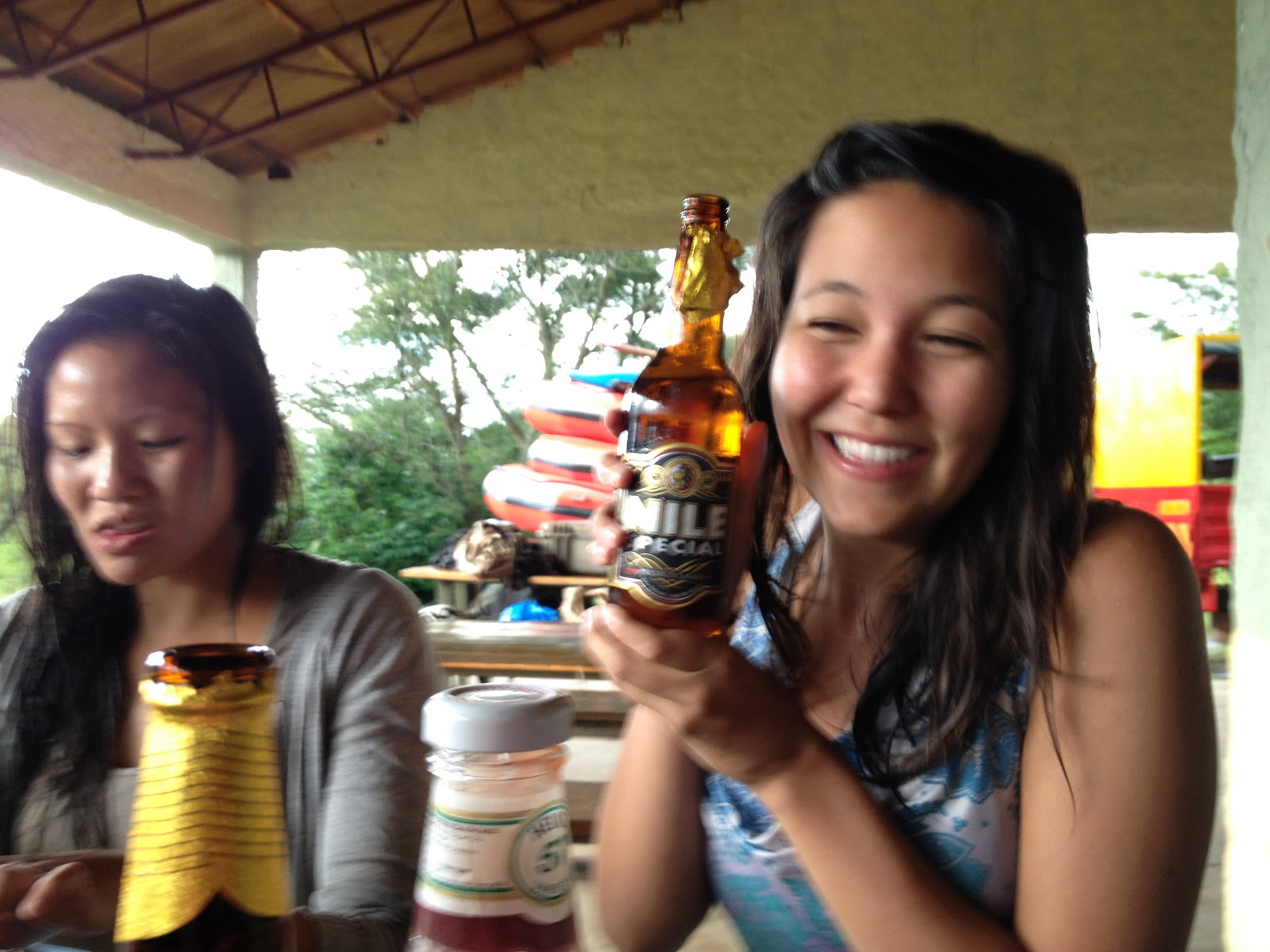
After being on the Nile for the entire day, we ate lunch and enjoyed a Nile Special (a Ugandan beer). It seemed to really fit the occasion. We all agreed that our bodies were so exhausted but on the river, we didn't feel tired at all. It wasn't until we were on land that we could really feel the impact. When we arrived back in Kampala, my friend and I decided to go for a dinner celebration at a place that my flatmate recommended. And let me tell you, there is nothing better than ending an crazy day than some good food and a cozy resturant. Over dinner, my friend and I kept replaying the adventure and we couldn't believe at some of those instances that no one got hurt! Now, I warn anyone who is thinking about rafting on the Nile (or rafting rapids) that it's not for everyone. If you aren't a strong swimmer, then don't do it. If you don't like near death experiences, then rafting may not be for you. Not saying that you're close to dying when rafting, but your mind thinks you are when you can't see anything but water is all around you and waves are crashing over your head.

Although the adventure ended on Saturday, Sunday was the icing on the cake...or in this case, CUPCAKE! My friends keep hearing me ask about where I can find cupcakes in Kampala. That's one thing that I miss that I didn't expect to really miss. So, for lunch on Sunday, they surprised me with cupcakes! I couldn't have asked for a better set of friends (all over the world) and a better birthday. Thank-you everyone for your birthday wishes and making my birthday the best yet! Next year will be hard to top this one.


Please feel free to leave a comment or question. I think the comment box is working now. :)

Friday, November 2, 2012

Safari yangu ya Tanzania

Mt. Kilimanjaro in the distance. A bit cloudy but still amazing.
That's right! This post is dedicated to my safari to Tanzania. This is not going to be about Rotary, but instead my realizations of how Tanzania is such a beautiful country with a very interesting past!  I am now determined to go to the museum in Dar es Salaam when I return in a few weeks. Though Tanzania (TZ) may not have nearly as many resources as Uganda, it does have almost every climate possible. From the beaches of Dar es Salaam and Zanzibar, the dry deserts of Serengity, to the cold climate of the mountains and of course, Mt. Kilimanjaro. I was amazed at how big Tanzania is as well, so I decided to write a post dedicated to the beauty of Tanzania and also some questions that I have about the country as well.

First, I should tell all of you that the national language is Kiswahili. We usually call it Swahili in the west, but it's proper name is Kiswahili. It's quite an easy language to learn. I've actually picked up on quite a few words (as some of you have noticed if I emailed you or responded to your questions with some random kiswahili thrown in the sentence). I'm actually going to take it upon myself to learn kiswahili for a couple of reasons. One: my research - when some Rotarians referred me to a website that relates to my research, I was thrilled that it was so easy to get information! But then, once on the website, I realized that it was entirely in Kiswahili. This is a hiccup in my research plans but not so much that I'm going to have to alter my research methods. I'm just going to have to learn how to read and speak it. Hakuna Matata! Two: Tanzanians are great at speaking kiswahili, but not so much at speaking english. It's hard for me to be understood and for me to undestand them. Even though english is the official second language, it's clearly not widely used among Tanzanians. So, it would be in my best interest to learn kiswahili for the sake of getting around the country.  The best part about learning kiswahili is that I don't have to change my voice in order to speak it! If you have ever learned a language like French or Spanish, you know that there are some words or phrases that require you to alter the tone of your voice in order to mean  one thing or the other. In kiswahili, the way it's spelled is the way it sounds.

I was also so shocked at how polite the Tanzanians are. After every verbal exhange, a person will say "Asante Sana" which means "Thank you very much". Often times, I felt so weird saying it after every little thing, but that's the way it is in TZ. People are generally more laid back a polite. This made me question the culture of TZ, why was everyone so laid back? And I recalled some of the readings I had come across for my research and even some conversations with some Tanzanian Rotarians about the history of Tanzania. I know not many people like history and all that boring stuff so I'll keep it simple.

Tanganyika ( it was not called Tanzania until Tanganyika and Zanzibar united in 1964) was colonized by the Germans, then practically sold to the British. In 1961, Tanganyika got it's independence from the British much like how Uganda and Kenya did a few years later, by the British setting up their constitution and putting a system in place that would allow the people to continue to function as a country. The first independent government functioned as a socialist government in order to ensure equality to all of it's people. That didn't really work out as great as they had hoped, so the president stepped down and handed over the power to a more democratic government.  Those socialist ways are still in place, so to speak. An example of this is that the TZ government owns all the land and a person just rents the land from the government for about 99 years.  Interesting isn't it? It is to me, mainly because I attributed the laid back mentality of the people to the government's power.  Why should a person stress out about things when the government is going to take care of it all? That question sounds very similar to some debates over government assistance in the U.S. doesn't it?

Statue of a Maasai warrior.
Another interesting thing about TZ is the culture...which has been lumped into one big pot.  I know this seems confusing, so I'm going to compare TZ to Uganda. Uganda has kingdoms and tribes and clans. One can belong to the Buganda kingdom, or be an Acholi or Bokica (pronounced Bo-chi-ka in central Uganda). But, in Tanzania...you're first and foremost a Tanzanian. THEN you're a part of a tribe, but even then, the tribes don't have such a strong hold on a person as it does in Uganda. I was fascinated by this, not just because it directly related to my research, but mainly because for the first 2 months of the scholarship year, I had been in an country where I constantly was asked which tribe I belonged to or asked if I was Bokica or Buganda. The only question  I was asked in TZ about my origins was if I was Kenyan and Rastafarian. I did see plenty of Maasai warriors in the traditional Maasai wardrobes as security guards, but that's about as much historical culture I witnessed in TZ.

All in all, Tanzania is a beautiful country. I realize that I have so much more to write about the country and it's relations to Zanzibar in particular, so I'll save that for another post.  If you're planning on visiting TZ to go to the beach, go on a safari to Serengity or do what almost every mzungu does and climb Kilimanjaro, make sure to learn a little Kiswahili. Even if you mess up with the words, they're so kind that they'll help you learn. With the kindness of the people, the beautiful landscape, and great food, you too will be singing hakuna matata like Timon and Pumba in the Lion King.


Monday, October 29, 2012

My Rotary Moment

There has been so much that has happened in the past couple of weeks that I’m going to have to write multiple post this week in order to cover it all. I first want to discuss my recent travels to Tanzania with the District Governor (DG), Geeta Manek. I truly believe this is the first time that an Ambassadorial Scholar has travelled with the District Governor to make club visits. Although the DG was the main guest speaker, I was able to speak for a few minutes as well.  I was the living & breathing example of what the Rotary Foundation can do for a community and young people. It was quite interesting for me to sit among the Rotarians and guest, barely saying a word, until the DG would ask me to stand up and say a little about myself and why I was there. Quite a shock and awe factor if I say so myself. Most of the time, the Rotarians were shocked because I didn’t look like a typical Mzungu (foreigner) but look East African. So in the course of two weeks, I was able to complete all of my club visits while in Dar es Salaam, Zanzibar, Tanga, Moshi, and the Kilimanjaro region.

I am actually quite happy to be travelling with the DG throughout my scholarship year because then I get to see how diverse Rotary is in east Africa as well as discuss my research with people all over the region. I also get to meet some interesting people and learn about the different projects that each club is doing (or not doing). As a Rotaractor, this is quite different for me. I get to sit in on the board meetings and see what goes on behind the doors so to speak. Every club has a different culture and that makes my experience here in East Africa all the more different.

I am shocked at how the clubs that were older seemed to be comfortable where they were. That’s to say that they didn’t feel the need to visit other clubs, recruit as much for new members, and their service projects were mediocre to say the least. I find that to be a human reaction to things. When one is in a position for too long, they feel comfortable where they are and ultimately hurt themselves.  While the small and oftentimes rural clubs were trying really hard and serving the community.

The most touching club that we visited was the Rotary Club of Lushoto. It was quite a hassle to get to the club, so I was a bit uneasy about what to expect. I was fully expecting the members to be exclusive given that their location was so remote. But then, in the cold mountains of Lushoto, I had a Rotary moment. If you’re not familiar with a Rotary moment, it is basically a point and time when an individual realizes the magnitude of Rotary.  It can push someone to join Rotary or Rotaract/Interact, or it can be the catalyst for someone to do more in the Rotary family. But nonetheless, it’s a positive experience that shows the good things that Rotary has done, is doing, and will do. The Lushoto Rotarians weren’t as flashy as the Rotarians in Dar es Salaam, social as the ones in Zanzibar, or even as hyper as the ones in Kampala. But they cared for their community, and that was evident. It was one of the few times where I really wanted to be a Rotarian. I didn’t feel odd or left out. I felt like I was a part of a family, a growing family that would accept me no matter what my faults or disabilities may be.

Most rotary moments, you hear about someone realizing the power of rotary via a service project or speaking with someone that has had a Rotarian help them in life. But mine was quite personal in that I’m realizing that no matter where in the world I may go, Rotary and Rotarians stand for the same thing. I had the honor of pinning a young man who was about 2 years older than me and tell the Rotary Club of Tanga what Rotary meant to me. At first, I was completely nervous and didn’t know what to say. I kept asking myself “what does Rotary mean to me?” As I listened to the country chair of Tanzania Jayesh speak to one of the new members as he pinned him, I realized that Rotary is like a religion, its personal to everyone - we all get something different from our experience with the organization. But we are all family and friends around the world under the Rotary umbrella. That’s what the Rotary wheel means to me. Each spoke is a different walk of life, but they all come together for one purpose. You can be sure that if you were to visit another part of the world and meet a Rotarian, they will be kind and generous, there to help you if need be, and there for you to talk to if that’s what you need as well. In the Rotary family, you’re never alone.  I’ve only been a rotaractor for two years, but I have gotten so much out of Rotary already and I am so happy to give back to not just Rotary, but the global community.


Monday, October 8, 2012

Ugandan Women’s Movement…but is there an International Women’s Movement?

Check out the four different flags Uganda has had over the years
The mayhem of turning 50 has begun for Uganda! This is a first for me, I’m used to hearing about founding fathers (and mothers), watching a documentary on some elderly men wearing make up and wigs speak of the enlightenment period which was greatly influenced by Thomas Paine’s “Common Sense” and many other enlightenment period thinkers. But this independence celebration is so different! There wasn't any mention of the colonial period or imperialism, but the struggle for rights through the past 50 years.The transition of power from one leader to another, and much talk about the current state of the country. But Ugandans are so happy to be turning 50! Infact, I began celebrating by attending the Ugandan women’s movement conference on Friday morning. That was quite interesting to listen to and attend because the U.S. doesn’t have a women’s movement any more…so to speak. Of course, we have feminist and women’s rights advocates, but the movement isn’t organized with a set agenda such as the Ugandan Women’s Movement. There was so much discussion about getting a female president, something that was a hot topic in the 2008 election with Hillary R. Clinton. But I kept questioning while listening to all of these strong women, is their society ready for a strong female president? I know the U.S. wasn’t ready for various reasons, but could it be possible for a country like Uganda to have it’s first female president after Museveni? Or even its first female chief justice?

A lot of their struggles are just the same as American women’s problems, child care availability and affordable health care. Women’s health, women’s right to choose (not abortion, that is actually illegal and it says so in the constitution, but rather to choose her relations with men), and of course, female education and eliminating domestic violence. But I think the feminist of the U.S. can learn something from the feminist of Uganda. They are so united in Uganda and all of East Africa to be honest. It was quite inspiring! I even ran into another American at the conference and she agreed with me that the women’s movement in the U.S. was non-existent because there are so many negative connotations with being a feminist. Perhaps that is something that the younger generations can work on as time goes forward in the U.S. But here in Uganda, the young females are on fire for equality and so were the older women.

What shocked me was that there was even a Uganda’s Women’s Anthem! My favorite part of the song is the chorus:
Mothers, Daughters

All women every where

Stand up and embrace

Your role today

I think that line to should be the Internationals Women’s Movement anthem! Women all over the world shouldn’t be afraid to stand up for their rights. We’re all in this together. And if you see another sister being abused or mistreated, don’t sit there and ignore the issue, that’s what I took away from this women’s conference. There are times when we can’t look to the government or the U.N. to help us, sometimes, the most powerful tool is ourselves. It was just such an inspiration to see the Ugandan women from all over the country come together for one cause. I think many causes could benefit from the Ugandan Women’s Movement model.